Charles White
3D Printed 120 Film Camera
2021 / Project

Role:
Designer/ Manufacturing
Date:
Fall 2022
Design Goals
Lomography has a “build your own camera” kit that uses a cardboard body to mount a plastic shutter and liquid-filled lens to. I got this kit and very quickly got frustrated with the limitation of cardboard in construction. To remedy this I decided to create my own camera body to mount the lens and shutter to.
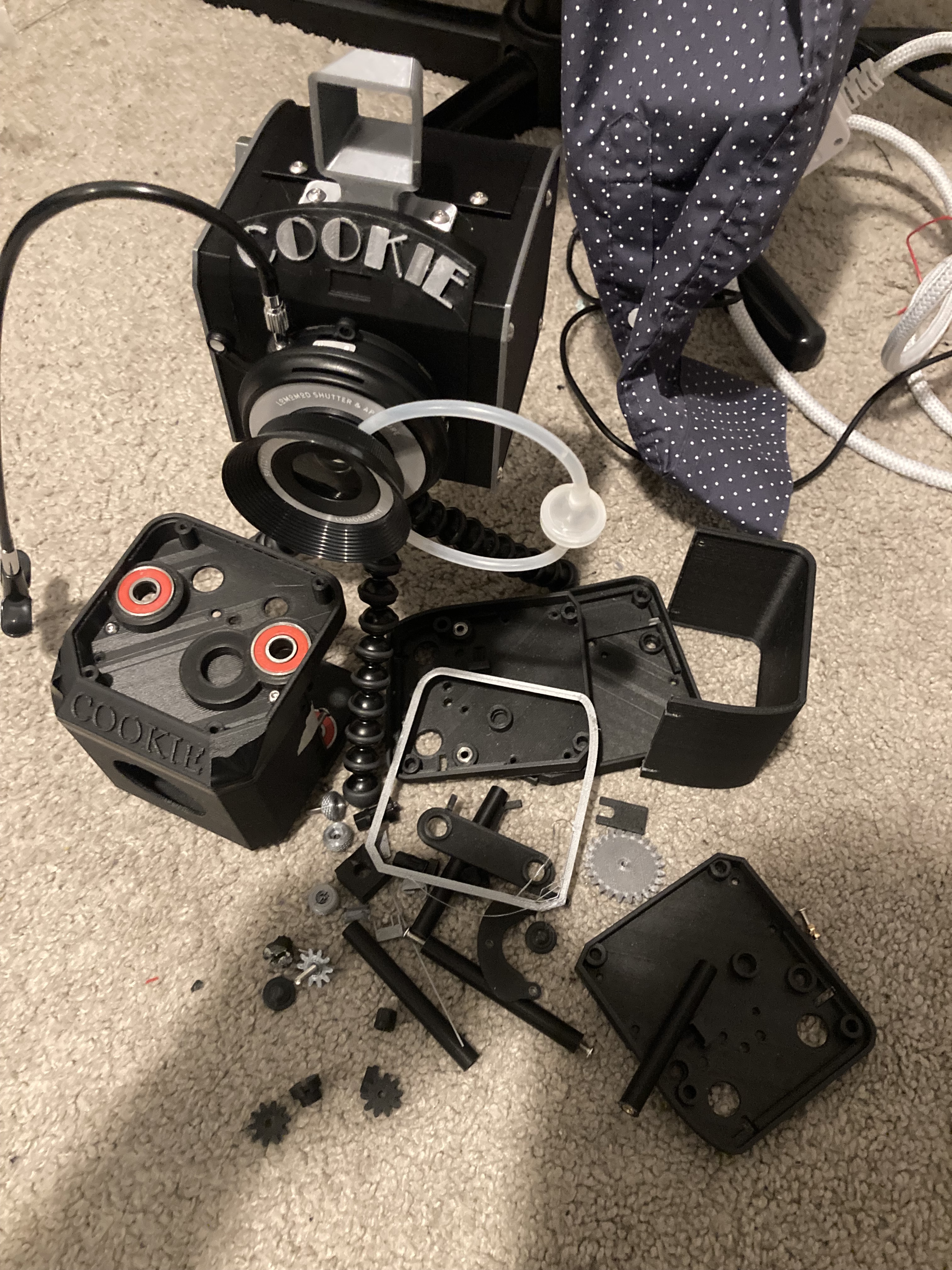
I would 3D print my design instead of folding cardboard. This would allow me to make the camera body much more sturdy and light-tight, both of which would make it much easier to use. 3D printing would also allow me to implement a better frame-counting system. The cardboard body used an old-fashioned window slide system. These systems require a hole to see through to the backing paper the film is attached to. While this works, it does provide an opportunity for light leaks. The 3D printed system would use a series of gears to create an external indicator that would allow me to know when the next frame was reached without letting in any light. The 3D printed body would also allow me to make a more compact body than that of the cardboard design. Finally, the 3D-printed body would not dissolve in a light rain.
To create the body I had to take two major measures from the original cardboard design. These are the diameter of the mounting hole for the lens/shutter assembly, and the flange focal distance. The flange focal distance is the distance from where the lens is mounted to the body, to where the film plane rests. If this distance is incorrect, the camera could not achieve focus.
The component that required the most troubleshooting was the roller with which the film would interface with the external frame counter system. This system required high friction between the roller and the film’s backing paper. If the film slipped on the roller, then the external indicator would be incorrect, and the film could overlap frames, or waste film with too much spacing in between frames. This problem was compounded by the resistance in the gear train that would translate the rotation of the rollers to the rotation of the indicator. This system required a large amount of tuning to ensure it did not create enough resistance to cause the backing paper to slip.
After this work and reworks, the camera reached a functional state. I would like to further improve the design, mainly with attention to the lens and shutter components. The current ones are off the shelf and designed by Lomography. I would like to design my own and design them with more flexibility.


 cliamwhite